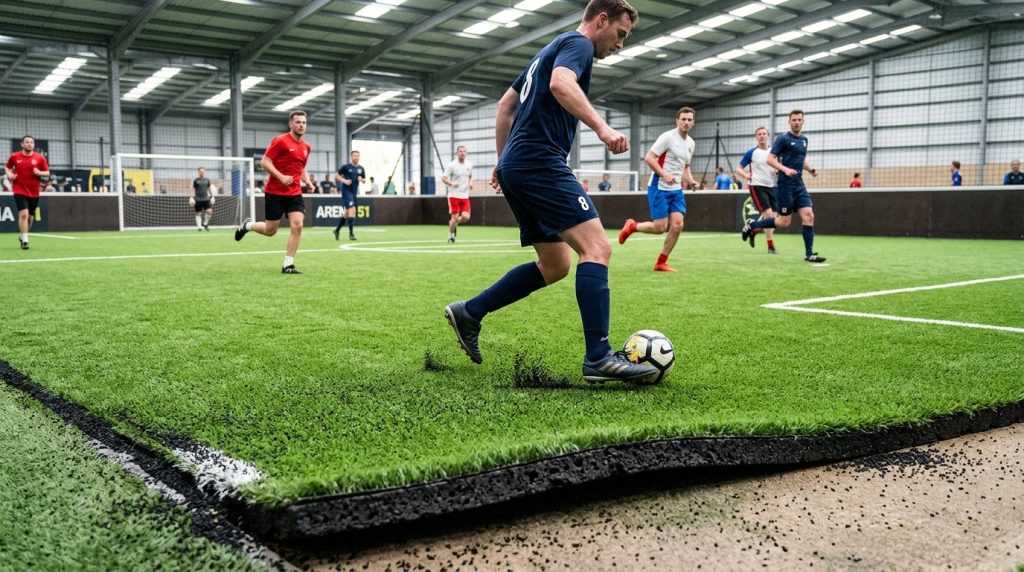
Indoor soccer field rentals demand a surface that feels consistent across repeated bookings, supports quick changes of direction, and simplifies upkeep. The right indoor soccer turf infill and shock pad work together, but neither choice suits every building or rental program. Understanding the trade-offs helps operators select indoor soccer field flooring that balances comfort, traction, maintenance, and long-term performance.
Choosing Indoor Soccer Turf Infill for Rental Fields
Infill supports traction and cushioning while helping turf fibers stand upright. For artificial turf rental fields, the right material also needs to suit indoor cleaning routines, ventilation, and the facility’s expected use.
Rubber, organic materials, and polymer options each behave differently. A material that performs well outdoors may not suit an enclosed venue, where dust, odor, migration, and maintenance carry greater importance.
Comparing Turf Infill Options
Consider these turf infill options alongside the turf pile, shock pad, and manufacturer’s recommendations. Ask suppliers for performance data and test results that match the intended system.
- Ambient SBR rubber offers impact absorption, durability, and recycled content. Its irregular granules can create air pockets, but those gaps may encourage migration.
- Cryogenic SBR rubber uses smoother particles that support more consistent water flow and reduce dust, odor, and compaction compared with ambient granules.
- Coated SBR and Pro-Gran add a polyurethane layer to recycled rubber. Green or brown coatings improve appearance and can reduce odor; Pro-Gran also targets coating durability.
- Cork and olive-core infill offer organic, recyclable alternatives. Cork can reduce surface heat, while olive-core material resists floating and can simplify maintenance.
- PE, EPDM, and TPE granules offer polymer-based choices. Some versions resist dust and odor, while TPE supports recycling and reuse.
Indoor soccer field rentals demand a surface that feels consistent across repeated bookings, supports quick changes of direction, and simplifies upkeep. The right indoor soccer turf infill and shock pad work together, but neither choice suits every building or rental program. Understanding the trade-offs helps operators select indoor soccer field flooring that balances comfort, traction, maintenance, and long-term performance.
Choosing Indoor Soccer Turf Infill for Rental Fields
Infill supports traction and cushioning while helping turf fibers stand upright. For artificial turf rental fields, the right material also needs to suit indoor cleaning routines, ventilation, and the facility’s expected use.
Rubber, organic materials, and polymer options each behave differently. A material that performs well outdoors may not suit an enclosed venue, where dust, odor, migration, and maintenance carry greater importance.
Comparing Turf Infill Options
Consider these turf infill options alongside the turf pile, shock pad, and manufacturer’s recommendations. Ask suppliers for performance data and test results that match the intended system.
- Ambient SBR rubber offers impact absorption, durability, and recycled content. Its irregular granules can create air pockets, but those gaps may encourage migration.
- Cryogenic SBR rubber uses smoother particles that support more consistent water flow and reduce dust, odor, and compaction compared with ambient granules.
- Coated SBR and Pro-Gran add a polyurethane layer to recycled rubber. Green or brown coatings improve appearance and can reduce odor; Pro-Gran also targets coating durability.
- Cork and olive-core infill offer organic, recyclable alternatives. Cork can reduce surface heat, while olive-core material resists floating and can simplify maintenance.
- PE, EPDM, and TPE granules offer polymer-based choices. Some versions resist dust and odor, while TPE supports recycling and reuse.
Supplier claims need context: ask whether testing applies to the specific product and installed system. Some manufacturers report that their infill materials meet or exceed EN 71-3, a standard used to assess certain substances in children’s toys and materials. That claim does not replace checking local requirements or installation guidance. For a reliable result, indoor soccer facility operators can consult a specialized turf installation professional to compare infill materials, shock pad systems, and maintenance requirements based on their building and rental needs.